Catering to Your Insurance Prospects

Whether you are new to the insurance industry or have been selling policies for a long time, one thing is for sure: in order to successfully build your business you need to know where to find insurance leads and be good at keeping customers. So where can you find prospects that are genuinely interested in getting a quote?

The easiest way to get the job done is to let the people in the communities you serve know you are an agent who will cater specifically to them. Consider who is in your local community and adjust your approach to their unique circumstances. Here are some strategies for local insurance marketing to insurance prospects that reach various target audiences.

  • Seniors – If there are a lot of homebound seniors in your neighborhood, bring your office on the road. You can get the word out about the services you offer by hosting regular insurance seminars at the various senior centers in town, at city hall, or even in the community rooms at the assisted-living centers.  Another good way to entice seniors to do business with you: offer to come out to their home to answer their questions about insurance so they won’t have to drive to your office.  Don’t show up unannounced however. Only visit a senior’s home if you have been invited.
  • Professionals – If most people in the communities you serve work full time, offer staggered hours. On some days open early, like at 5:30 a.m. or 6 a.m.; on other days close late, like at 6 p.m. or 7 p.m. This way people can get their personal matters taken care of without having to schedule time away from work.  Another way to cater to this audience would be to staff the office on weekends. If you decide to go to all the trouble to change your hours, be sure to get the word out. You can put an ad in the community paper or perhaps have a postcard made and sent to households in the zip-codes you serve.
  • Ethnic neighborhoods – Do a large number of your potential customers speak a foreign language, like Spanish or French? If so, create bilingual materials. You may also want to hire a translator to be available at the office a few days a week and advertise the fact that you offer this service. The local community newspapers are a great place to take out an advertisement. You can typically purchase a small ad for as little as $25 or $50. If you ask, some may even make a mention of your service for free as a community service.
    Apartment complexes – A recent survey by the Insurance Research Council found that while 96 percent of homeowners carry insurance for their residences, only 43 percent of renters have it. If the communities you serve have a significant number of apartment complexes in them, educate the residents and you’re sure to bring in some new business.

A good way to reach apartment complex residents is to drop off flyers that can be placed in the mailroom or community room. You may also want to ask management if they would be open to letting you host a free quarterly seminar for residents during which they could get their questions about insurance answered.  If you are able to set a seminar up, make it enticing by serving a snack, or offering chocolates with the name of your company on the wrapper. Be sure to also bring along plenty of brochures and tip sheets. People love takeaways. Lastly, most consolidated communities like apartment complexes have bulletin boards where tenants can advertise to one-another. Place a flyer or some business cards on these to catch the attention of tenants looking to stay connected.

In the competitive world of enticing insurance prospects, the agent who tailors his approach most carefully to his local demographic profile stands to make large gains. It pays to take the time to really get to know the communities you serve.

Informational Source

4 Remarkable Ways to Grow as an Independent Insurance Agent Faster than Your Competitors

You’d be shocked if we tell you how much many independent insurance agents and brokers are making as salaries every month.

We are sure it will make you wonder where the heck are all the billions of dollars available in the insurance industry are going to.

Yes, we also thought that way until we were able to discover that many independent insurance agents aren’t really applying what would make them grow. Instead, very many of them are busy chasing the wrong things that will only make them peanuts as commissions and bonuses.

If you are set to grow as an independent insurance agent faster than your competitors, here are 4 remarkable ways to start.

Find More Jobs

The insurance sector is such a fast growing one. As fears of more calamity and uncertainty in government policies rise, the need for insurance coverage becomes more glaring. In the other hands too, if the economy improves, insurance companies also grow.

Guess what the good news is, these companies are known for the culture of hiring the services of independent insurance brokers. But, except you are spectacular, this job opportunities won’t knock at your doorpost, so you have to go out to look for them. This is if you are serious about growing your independent insurance agency.

As you proceed in your search for better job opportunities, here’s a perfect guide on how to find the best insurance companies, especially in the auto and car sector.

Get More Clients to Renew their Insurance

Independent insurance agents working in New York and Washington D.C. are generally known for earning larger commission on renewals than those of their colleagues in other parts of the United States. This is reasonably due to the fact that more people renew their insurance, and secondly, because of the high cost of living.

The more renewals an independent insurance broker gets for the companies he recruits for, the higher the commissions and bonuses he will make. In that case, whatever tactics you think are legal are worth doing if you want to grow your insurance agency.

Obtain More Qualifications

While it’s permissible for you to start with just high school diploma, it will be to your best interest to keep upgrading your qualification if you want to grow your agency faster than your competitors are doing.

In the U.S., an independent insurance agent can be allowed to start with high school diploma but they must pass a state exam done through the American Institute for Chartered Property and Casualty Underwriters to qualify them.

Wondering what some of the different types of insurance certifications are available? First, check what their minimum education and work experience requirements before you proceed.

When it comes to general insurance industry certification, The National Alliance for Insurance Education and Research will teach you things like, how to issue commercial casualty, commercial property, personal residential and personal auto insurance.

How about specific insurance courses that will contribute to a large extent in helping you become or grow as an independent insurance broker and agent? Check this blog post.

Start Using Social Media to Grow Your Insurance Agency

Nowhere has social media turned out to be less effective. In every industry, social media can play a key role when handled by an expert.

As an independent insurance broker who already knows that his income is dependent on the amount of commissions and bonuses he’s able to get, you ought to get your message out to prospects on social media. Using LinkedIn for instance, will go a long way in helping you get unique leads because that’s where most of the people who can afford your services congregate.

Amazingly, if you can write a free report, checklist, toolkit or whatever it is, do it and offer it for free to get them into becoming qualified leads. It’s easier selling on social media if the people you are trying to sell your insurance package to already know, like and trust you.

Conclusion

Every sector comes with her unique challenges. In the insurance industry, there about 3 challenges that tends to pose as a serious problem to newbie. If after reading this post you still find yourself struggling to grow your agency, then you should do yourself a favour by reading it all over again.

Informational Source

Why You Should Purchase Riders with Life Insurance Policies

Living and working as one whose family depends on for their financial support can be very risky without a life insurance policy.

In the case of unfortunate eventuality which can come up at any time, only the financial security of your family is what will determine if life won’t become miserable for your dependents.

Though life insurance policies on their own already guarantees a risk cover and some interesting payouts to policyholders, purchasing a rider is an intelligent way to increase the coverage offered by your policy.

What is Insurance Rider?

Different life insurance companies offer different riders based on the plan you are in. However, some of the most popular riders offered by most life insurance companies are:

1. Critical Illness Riders

When one is diagnosed with critical illness, it puts a significant pressure on the person’s finances. Of course, you already know that healthcare cost across the United States have increased.

Having an understanding to this, it important that you purchase Critical Illness Benefits Rider together with your life insurance policy. This will help to take the pressure off your personal finance. However, always ensure you check the specific critical illness that were cover by the rider. We’ve had cases of people losing their insurance coverage in this area.

2. Accidental Death and Disability Rider

Though most life insurance policies provide a risk cover against sudden death, however, when you purchase Accidental Death and Disability Benefit Rider, it guarantees that your insurance nominee will receive a higher payout if anything happens and you are gone. Such eventuality ought to be prepared for.

Additionally, since the regular life insurance policy don’t cover the risk of being permanently disabled, purchasing a rider could be your only savior. The payout you will be receiving, though may not be big but it will serve as a good income replacement.

3. Waiver of Premium Rider

Insurance rider is a type of specialized coverage that can be purchased in addition to your standard policy. Rider is not a policy on its own and can’t be purchased independently. But it’s added on demand to help protect a policyholder from certain eventualities.

If you are ready to purchase riders, it’s important that we remind you that it comes with an additional cost but it’s never something you can’t afford. For buying your base insurance policy from a firm, you qualify for their discount on riders.

Instead of trying to maintain a separate a policy, we recommend you purchase riders alongside with it so that you will get a chance to customize it the way you want.

Types of Life Insurance Riders

Often times, when an eventuality happens and there’s an accident that results in one being disabled, it makes the person impotent to pay for premiums towards his base insurance policy. But with a Waiver of Premium Rider, the policyholder’s future premium payments will be waived off, and he or she will still be eligible to continue receiving the policy benefits as per schedule.

Having said all these, before you purchase riders, make sure the sum of the riders don’t exceed the base insurance policy and that both terms are dependent on each other.

Informational Source

Why We Ride Out Life-Threatening Storms and Do Other Crazy Things

It’s called denial. And denial is hope on steroids.

I’ve been wrestling with a chronic problem we in the insurance industry haven’t been able to crack for centuries.

It’s called denial.

I’m referring to the seemingly innate refusal of the human mind to appreciate the gravity of a potential disaster before actually experiencing one. As humans, our bias toward denial tempts us to roll the dice, buy scratch tickets, drive fast, jump off cliffs, eat fatty food, ignore our retirement funds and generally take too many chances.

We let smoke detector batteries die. We build homes in the same flood plains where our last ones were destroyed. When a monster hurricane like Michael is bearing down, some of us ignore evacuation orders thinking our grit will enable us ride it out. It happens every time.

You see denial on the macro level, too. Global companies rely on risky partners only to see their supply chains snap. Power blackouts endure for weeks because no one bothered to build a resilient infrastructure. Skyscrapers go up in flames because they have flammable cladding yet no automatic sprinklers.

Generally, people don’t respect the power of potential disasters, and they don’t adequately plan for them.

My colleagues did some research on denial a while back. Ninety-six percent of the financial executives we surveyed said their operations were exposed to natural catastrophes like hurricanes, floods and earthquakes. Yet fewer than 20 percent said their organizations were “very concerned” about such disasters hurting their bottom line.

Let’s face it. Denial is hope on steroids.

In a report we published in 2010, Flirting with Natural Disasters, we described, for instance, the Gambler’s Fallacy — the misconception that what has recently occurred will affect what occurs next even if the two events are unrelated. For example, if flipping a coin nine times results in nine instances of “heads,” probability still applies: There’s a 50 percent chance the tenth flip will be heads. By the same reasoning, there’s no objective basis to think that the Carolinas won’t see another Florence-class storm this year, or next year.

We also outlined some other facets of denial: A person can worry about only so many things, so seemingly remote possibilities like natural disasters often fail to make the cut. Short-term pleasure is more appealing to consider than long-term consequences. It’s easy, but wrong, to conflate the inevitability of a natural disaster with the supposed inevitability of life and property loss. People think insurance makes you whole. (If you think that, ask a disrupted business that lost its market share to resilient competitors if it was made whole.) And: Most people are followers, thus institutionalizing the practice of denial.

To try to snap people out of their denial, my insurance colleagues and I share real-life tales with anyone who will listen. And we try to recast the notion of probability like this: A hundred-year flood doesn’t happen every 100 years; rather, it has a 1 percent chance of happening every year.

So, are you worried now? Probably not. Thus, humans continue to take chances. And when they get away with them, they take more chances. Conversely, when they lose, they learn. Unfortunately, they usually learn only when they lose.

Given this conundrum, I propose that we in the insurance/disaster management world try something new. We need to find ways for people to encounter disasters without actually living through them. We call it pre-experiencing disaster.

We’re trying this at my workplace for clients and would-be clients. We create six-story controlled warehouse fires and trigger actual explosions. We simulate hurricanes, floods and cyber attacks. We have a platform that mimics the motion of an earthquake and shows how violently and unpredictably a building will move, and even rotate, when the ground shakes.

Our visitors feel the heat from the fire. They cringe as a two-by-four hurtles across a room in a simulated hurricane. Their bodies absorb the concussion of an explosion. When they leave, they seem converted.

We need to do this kind of education in a broader way that reaches people and businesses in vulnerable communities, places that face threats from hurricanes, tornadoes, earthquakes, flooding and wildfires.

In schools, we need to weave disaster and denial stories into classes on physics, earth science psychology, engineering, finance, statistics and the building trades. We need to find ways to tell the stories of people who suffered because of their denial, and who survived because they took the right precautions and built in the proper safeguards.

Communities at potential risk should bring in engineers and emergency workers to point out what could fail, wash away, freeze, rot, short-circuit, explode, shatter, cave in or burn up.

“See these wedding photos?,” they might say. “Might as well toss them in the creek.” Or: “Your classic car? It will be a boat that doesn’t float.” Or, to a utility executive: “Your power plant? Heaven forbid a storm surge comes your way.”

And governments and insurance companies should share more widely the eerily precise predictions we’re getting from big data. At my company, we can, for example, pinpoint the single data center in a global company that is most likely to be underwater when a flood strikes.

In other words, we should unleash the power of predictive analytics and bring it to the doorsteps of people who live in harm’s way, even though they deny it.

All of this education — this pre-experiencing disaster — would underscore the critical need to focus on prevention and building resilience against threats that are easier for people simply to deny.

Those who have experienced a real-life disaster already understand how disruptive it can be to their lives, communities and businesses. They discover that the turmoil is usually worse than people imagine and lasts longer than they expect. They come to realize that vulnerability is a choice, as is building resilience against potential threats. Once enlightened, they choose to identify the risks they face and address them head-on.

For others, the standard warnings may fall on deaf ears. But if they could pre-experience a catastrophe, perhaps they would listen up and take some precautions.

Informational Source

Cashless Claims in Health Insurance: Why is it important?

Health insurance has always been one of those few instruments that we don’t pay too much attention to. However, it is one of the most crucial investments that we make, which helps us in emergencies. While most of us look for a decent cover scheme at a nominal premium, an ideal health insurance provides several benefits that we may often overlook. The rising cost of medical care in India, combined with the hassle that some claims have made people experience, is finally making us put some serious  ..

Why is cashless claim important?
One of the most common financial hassles that we face at hospitals is paying the fees, deposits and handling all the other lengthy paperwork that comes with any medical emergency. At a time when we would like to stay with our family and support them, we are left managing the documents and cash, which merely adds to the emotional stress. With a cashless claim, you can avoid these hassles and make the process swifter and quicker. It takes away the stress.

What is the cashless claim process?
Health insurance companies have made the hospitalization process even easier with the assurance of cashless claim processing in less than 30 minutes. With their presence in all leading hospitals, has been a pioneer in this service. While finding a suitable hospital which offers cashless claims was once a task, the increasing inclusion of various major hospitals has made this woe disappear as well

In addition to the cashless claims feature, there are multiple other things that you need to look for while choosing a health insurance – from the flexibility of the insurer to cover alternative treatment options to added rewards and benefits that the company is ready to provide based on no claims activities.

If you want to know more information about chip guidelines then please send your queries in the comment section.

Informational Source

Should U.S. Adopt Germany’s Health Care Model?

Dr. Daw holds up the German-style system of nonprofit private health insurers as a better model for the United States than a single-payer system. While I can understand why the professor believes that a German-style system “builds more naturally on the American health insurance system,” it’s hard to believe that it would meet significantly less resistance from the insurance industry than a single-payer system.

In fact, Dr. Daw actually explains why this is the case: “In an American version of this system, private insurers would have to be heavily regulated to ensure that coverage was affordable and to prevent the sort of rapid increases in premiums, deductibles and cost-sharing that have occurred over the past decade.”

Does anyone really expect that private for-profit insurance companies will willingly convert to nonprofit status and submit to tough regulations?

Bruce Shenitz
New York

To the Editor:

As an American who has lived in Germany for over 40 years and who is alive but not impoverished today because of the quality of the German health care system, I can only echo Jamie Daw. Democratic candidates would do well to examine the multipayer systems of Germany, Austria and the Low Countries and not concentrate on the less efficient single-payer systems of Canada or Britain simply because they are described in English.

There is a place for private insurance plans in a well-organized system. Indeed, as the German system demonstrates, those of us who earn enough to be better off with private plans can actually subsidize the care offered to the publicly insured, thus raising the quality for all patients.

Steven J. Sherman
Munich

To the Editor:

Jamie Daw would do well to confer with Senator Chris Murphy of Connecticut. He proposes opening up Medicare as just one more insurer, albeit a nonprofit one, and letting market forces play out as they will. That is, of course, a great oversimplification of the senator’s thinking, but the underlying logic is beautifully simple.

Dave Gliserman
Oxford, Conn.

To the Editor:

In her plea to Americans to adopt German rather than Canadian-style health insurance, Jamie Daw observes that we Canadians spend 3 percent of our health expenditures on administrative costs while the Germans spend 5 percent. The reason is simple: We have largely eliminated private insurance and bill the national health insurance plan directly for medical and hospital care.

When I had a heart attack and a double bypass operation some years ago, the only requirement was that I show my health insurance card to the hospital. Does anywhere in the United States provide the same efficiency in health care?

By contrast, the German system, as described by Dr. Daw, looks like American health care-lite — easier to afford, but still afflicted with private insurers and the incredible weight of bureaucracy required to keep the system honest.

Harvey G. Simmons
Toronto
The writer is emeritus professor of political science at York University.

To the Editor:

Jamie Daw argues we can transition from Obamacare to Germany’s universal health care system far more easily than we can persuade — whom? — to accept single payer. Poll after poll shows Americans long for a single-payer plan. But we cannot ignore the differences between a country that accepts limits on profiteering and one that celebrates any and all legal means of turning any “opportunity” into a buck.

As long as health insurance companies donate to politicians, we can’t hope for a government that eliminates their profits. Without getting rid of for-profit health insurance, we cannot get the obscene expense of treating illness in this country down to manageable levels. In spite of Dr. Daw’s optimism, we cannot transition from profitability to a system based on the values associated with compassion as long as health insurance companies continue to stand between us and the care we need to thrive.

Candida Pugh
Oakland, Calif.

To the Editor:

So let me see if I have this right: Because a German chancellor, Otto von Bismarck, came up with an inefficient way to provide universal health care almost 140 years ago, the United States should now copy his system?

There are too many flaws in Jamie Daw’s case to enumerate in a short letter, but let me take just one: Dr. Daw states, “In Germany, sickness funds leverage market power to secure lower prices, coming together regionally to negotiate contracts with doctors and hospitals.” In the United States, health insurance companies — which are much larger and have much more market power than German sickness funds — have had the ability to negotiate for lower prices for the better part of a century. The result has been what we have — by far the most expensive health care system in the world.

What on earth makes Dr. Daw think that, with a snap of the fingers, this already existing market power will suddenly yield a better result? Private insurance companies add an extra layer of expense that is totally unnecessary. We can do better.

Wesley H. Clark
Middlebury, Vt.
The writer is an anesthesiologist.

To the Editor:

I am an American expat who has been living in Germany for many years and have intimate knowledge of and experience with its health care system. Jamie Daw’s essay is not representative of the realities, pitfalls and serious systemic problems that exist in the German system and do not reflect the fact that most of the population is getting substandard care. Indeed, the German system is just as bad as the American system, just with a different set of failures that need to be addressed.

Stew Green
Brandscheid, Germany.

To the Editor:

One important aspect of health care that Jamie Daw does not mention is the education of medical providers. The cost of medical school in Germany is a tiny fraction of the cost in the United States. Medical schools can cost as much as $75,000 per year, or $300,000 in total, for tuition, fees and living expenses. During the additional four to eight years of internship, residency and fellowship, young doctors are barely paid enough to cover basic housing and living costs. Most are not only acquiring substantial debt but also forgoing about 10 years of earning and saving.

This is a huge sacrifice. We should be asking ourselves how much longer the best and brightest students will choose this career path unless the cost of medical education is not so onerous.

Candace Singer
Port Washington, N.Y.

To the Editor:

Several important features of the Bismarckian model advocated by Jamie Daw are omitted from her description of the German health insurance system. First, all of the sickness funds are, by law, not for profit; to introduce this needed feature into the American capitalist system is as radical as single payer.

Second, people earning above a defined (inflation-adjusted) yearly amount of money are not required to join the sickness funds, and can either pay out of pocket or find other insurance; this group comprises about 10 percent of the working force.

Third, the system operates under a gatekeeper system, in which primary care providers refer to hospital-based secondary and tertiary care providers.

My point here is that adopting a Bismarckian system is not necessarily simpler for the United States than establishing single payer. It is possible that a hybrid homegrown model might be better than either.

Informational Source

Medicare and the Trump Budget: Differing Views

The White House responds positively to an editorial about reform, though advocacy and hospital groups disagree.

To the Editor:

Re “Not All Medicare Cuts Are Bad” (editorial, March 26):

While your editorial board and the Trump administration may not always see eye to eye, this editorial finds important areas of agreement.

The president’s 2020 budget takes thoughtful steps to strengthen and protect the Medicare program for America’s seniors. In fact, the budget does not harm beneficiaries. It does not cut their benefits, nor does it increase aggregate out-of-pocket spending.

Instead, the budget eliminates waste and inefficiencies in the Medicare program, in line with the president’s campaign promise. One prominent example cited in the editorial is our push toward site-neutral payment. Why should taxpayers or seniors pay higher rates for a service at an outpatient hospital clinic than for the same service at a doctor’s office?

For example, seniors pay about $34 for a clinic visit at an outpatient hospital and about $15 for the same services at a physician’s office. This push is not a one-off occurrence; rather, it is something we have worked to embed in the system through the yearly payment process over the last two years.

We also publicly laid out the president’s philosophy on site neutrality in the December report, prepared by several federal departments, on “Reforming America’s Healthcare System Through Choice and Competition.”

As you noted, policymakers in both parties have failed to focus on managing the cost of care, and on reducing or eliminating bad incentives and inefficiencies in our system. Rather than take partisan shots at serious reforms intended to manage costs while protecting our seniors, we invite Democrats and Republicans to come together to work on common-sense reforms.

Senators Kamala Harris, Elizabeth Warren and Brian Schatz, who, as you note, oppose our plan, should know that our doors are always open if they wish to partner on reforms to protect American seniors and taxpayers.

Joe Grogan
Washington
The writer is director of the White House Domestic Policy Council.

To the Editor:

Our organizations agree that conserving Medicare resources to preserve the program for generations to come is an important goal. But we cannot support a budget that impedes access to care, and the president’s budget would do just that.

Among the problematic Medicare provisions are those that would make it harder for beneficiaries to obtain care by curtailing appeal rights, increasing out-of-pocket costs and expanding prior authorization.

Additionally, provider cuts of the magnitude proposed would likely be impossible to carry out without negatively affecting beneficiaries. And unlike the Affordable Care Act’s reimbursement changes, the resulting savings would not be reinvested in efforts to expand and improve coverage.

Notably, these Medicare spending reductions tell only part of the story. Older adults and people with disabilities look to a constellation of programs to stay healthy, many of which — in particular Medicaid and the health care law — would see steep cuts under the administration’s budget.

People with Medicare and their families deserve better. Working together, we can find ways to reduce health care costs without jeopardizing Americans’ health and economic security.

Joe Baker
Judith Stein
Mr. Baker is president of the Medicare Rights Center, and Ms. Stein is executive director of the Center for Medicare Advocacy.

To the Editor:

You call for slashing the “bonus payment” that hospitals receive for the outpatient services they provide.

Hospital-based outpatient services are reimbursed at a higher rate than physician offices because of the vast overhead costs associated with hospitals staying open 24/7 and never turning away patients.

Given those major cost drivers, the notion that the level of reimbursement for hospital-based outpatient services constitutes an unnecessary bonus payment is befuddling.

Many financially struggling inner-city and rural hospitals can barely sustain their outpatient services right now. Cutting their Medicare reimbursement for those essential services will severely compromise access to care for the vulnerable communities they serve, many of which have no other outpatient health care options.

Informational Source

Did your taxes disappoint you this year? Here’s how to avoid a repeat next year

Tax season has come and gone — at least for the more than 103 million filers who submitted their returns before April 15.

This spring marked the first time taxpayers and their accountants submitted tax returns under the Tax Cuts and Jobs Act.

The overhaul of the tax code, which went into effect in 2018, increased the standard deduction to $12,000 for singles ($24,000 for married couples filing jointly), eliminated personal exemptions and curbed a number of itemized deductions.

The Treasury Department and the IRS also updated the withholding tables last year to reflect the new laws. These tables, when used with Form W-4, help employers deduct income taxes from your pay.

Overall, individual income tax rates also went down.

Amid all of these changes, taxpayers have one burning question: “How did I fare under the new tax law?”

Many are looking to their refunds as an indicator of how they did, but those checks only tell part of the story.

The IRS paid $220.7 billion in total refunds as of April 5, down by about $6 billion from a year ago, according to the agency. The average refund check is $2,833, down by about $30 from last year.

“People are looking at the bottom line, which for them is the consequence of filing the return then and there: Did you get a refund or do you have a balance due?” said Nathan Rigney, lead tax research analyst at the Tax Institute at H&R Block.

Tax liability

Got your 2018 tax return? Dig up your 2017 return, too.

Focus on line 15 on your 2018 return and line 63 on your 2017 return, Rigney said. These tell you your total tax paid in those respective years. Compare the two.

“The first thing to figure out is did you have a tax liability problem? Or did you have a withholding problem? Was it losing the ability to itemize?” asked Jeffrey Porter, CPA and founder of Porter & Associates in Huntington, West Virginia.

A decrease in liability alone isn’t necessarily a guarantee you won’t owe the IRS in the spring.

For instance, if your tax liability went down in 2018, yet you also significantly didn’t withhold enough that year, you may end up owing.

Informational Source

Can Paying for a Health Problem as a Whole, Not Piece by Piece, Save Medicare Money?

A program called bundled payments appears promising, but we need more rigorous evaluations.

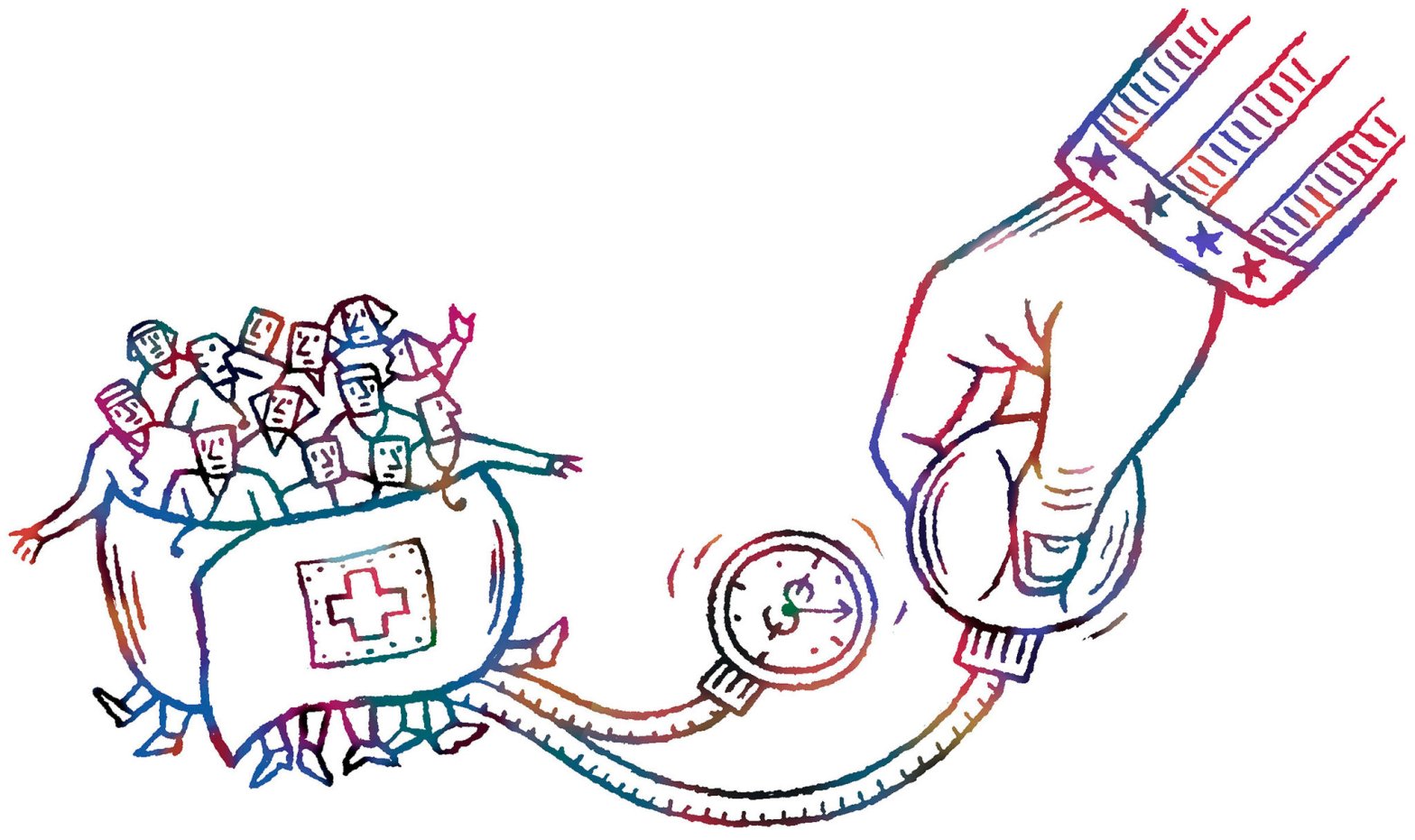
Among the standard complaints about the American health care system is that care is expensive and wasteful. These two problems are related, and to address them, Medicare has new ways to pay for care.

Until recently, Medicare paid for each health care service and reimbursed each health care organization separately. It didn’t matter if tests were duplicated or if a more efficient way of delivering care was available — as long as doctors and organizations were paid for what they did, they just kept providing care the way they always had.

But ordinary people do not think this way. We focus on solving our health problem, not which — or how many — discrete health care services might address it. New Medicare programs are devised to more closely align how care is paid for with what we want that care to achieve.

One of these programs is known as bundled payments. Instead of paying separately for every health care service associated with a medical event, you pay (or Medicare pays, in this case) one price for the entire episode. If health care providers can address the problem for less, they keep the difference, or some of it. If they spend more, they lose money. Bundled payment programs vary, but some also include penalties for poor quality or bonuses for good quality.

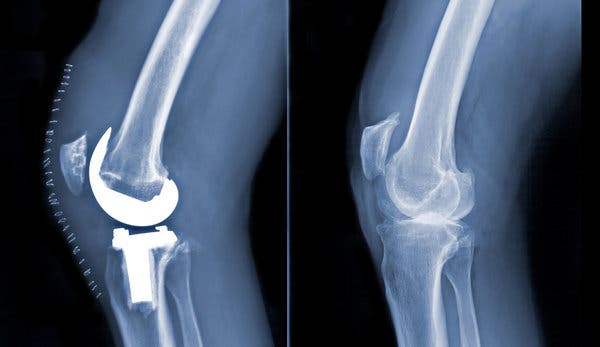
Medicare has several bundled payment programs for hip and knee replacements — the most common type of Medicare procedures — and associated care that takes place within 90 days. This includes the operation itself, as well as follow-up rehabilitation (also known as post-acute care). In theory, if doctors and hospitals get one payment encompassing all this, they will better coordinate their efforts to limit waste and keep costs down.

Do bundled payments work? They certainly appear promising, at least for some treatments. But it’s important to conduct rigorous evaluations.

Previous studies for Medicare by the Lewin Group and other researchers suggest that Medicare’s Bundled Payments for Care Improvement program has reduced the amount Medicare pays for each hip and knee replacement.

But that doesn’t mean the program saved money over all.

One possible issue would be if, despite saving money per procedure, health care providers wastefully increased the number of procedures — replacing hips and knees that they might not otherwise. A related concern is if hospitals try to increase profits by nudging services toward patients who may not need a procedure as much as patients with more severe and more expensive conditions. An average joint replacement costs $26,000, split almost equally between the initial procedure and post-acute care. But more expensive cases can be $75,000 to $125,000 — a costly proposition for hospitals.

A recent study published in JAMA examined whether the volume of Medicare-financed hip and knee replacements changed in the markets served by hospitals that volunteered for a bundled payments program, relative to markets with no hospitals joining the program. It found no evidence that the bundled payment program increased hip and knee replacement volume, and it found almost no evidence that hospitals skewed their services toward patients whose procedures cost less.

“These results suggest bundled payments are a win-win,” said Ezekiel Emanuel, a co-author of the study. “They save payers like Medicare money and encourage hospitals and physicians to be more efficient in the delivery of care.”

But Robert Berenson, a fellow at the Urban Institute, urges some caution. “Studying one kind of procedure doesn’t tell you much about the rest of health care,” he said. “A lot of health care is not like knee and hip replacements.”

Michael Chernew, a Harvard health economist, agreed. “Bundles can certainly be a helpful tool in fostering greater efficiency in our health care system,” he said. “But the findings for hip and knee replacements may not generalize to other types of care.”

Christine Yee, a health economist with the Partnered Evidence-Based Policy Resource Center at the Boston Veterans Affairs Healthcare System, has studied Medicare’s previous efforts and summarized studies about them. (I and several others were also involved in compiling that summary.) “Medicare has tried bundled payments in one form or another for more than three decades,” Ms. Yee said. “They tend to save money, and when post-acute care is included in the bundle, use of those kinds of services often goes down.”

One limitation shared by all of these studies is that they are voluntary: No hospital is required to participate. Nor are they randomized into the new payment system (treatment) or business as usual (control). Therefore we can’t be certain that apparent savings are real. Maybe hospitals that joined the bundled payment programs are more efficient (or can more easily become so) than the ones that didn’t.

Another new study in JAMA examines a mandatory, randomized trial of bundled payments. On April 1, 2016, Medicare randomly assigned 75 markets to be subject to bundled payments for knee and hip replacements and 121 markets to business as usual. This policy experiment, known as the Comprehensive Care for Joint Replacement program, will continue for five years. The JAMA study analyzed just the first year of data.

“In this first look at the data, we examined post-acute care because it is an area where there is concern about overuse,” said Amy Finkelstein, an M.I.T. health economist and an author of the study. “In addition, prior work suggested that it’s a type of care that hospitals can often avoid.”

The study found that bundled payments reduced the use of post-acute care by about 3 percent, which is less than what prior studies found. “Those prior studies weren’t randomized trials, so some of the savings they estimate may really be due to which hospitals chose to participate in bundled payment programs,” Ms. Finkelstein said. Despite reduced post-acute care use, the study did not find savings to Medicare once the costs of paying out bonuses were factored in. The study also found no evidence of harm to health care quality, no increase in the volume of hip and knee replacements, and no change in the types of patients treated.

“Savings could emerge in later years because it may take time for hospitals to fully change their behavior, “ Ms. Finkelstein said. In addition, the program’s financial incentives will increase over time; bonuses for saving money and penalties for failing to do so will rise.

On the other hand, Dr. Berenson said, health care providers could figure out how to work the system: “In three to five years, we may see volume go up in a way that offsets savings through reduced payments for a procedure. We’ll wait and see.”

Medicare put its best foot forward by using a randomized design. Not only were the markets selected in a randomized fashion, but providers in those markets were also required to participate. Though common in medical studies, randomization is rare in health care policy, as is mandatory participation. Nearly 80 percent of medical studies are randomized trials, but less than 20 percent of studies testing health system change are. Organizations that would be subject to the experiments often strongly resist randomizing health system changes and forcing providers to participate.

Unfortunately, the randomization of the Comprehensive Care for Joint Replacement program will be partly compromised in coming years. The Centers for Medicare and Medicaid Services announced last year that hospitals in only half of markets under the program would have to stay in it. Participation is voluntary in the other half, and only one-quarter of hospitals opted in.

Going to a partly voluntary program will make it harder to learn about longer-term effects, Ms. Finkelstein said.

If you want to know more information about virtual care providers then please send your queries in the comment section.

Informational Source

Talking About Money Is Extremely Hard. Do It Anyway.

I recently sent out an email asking people on my mailing list for a simple “yes” or “no” response to the following question: Is it hard for you to talk about money with your spouse or partner?

I got hundreds of replies. But buried in those replies was one that I found particularly difficult to read:

“The answer is YES! It is hard, because it often feels defensive. She spent too much. He spent too much. Was that aligned with our values? What are our values? How come there isn’t more? And if only she would spend less, then I wouldn’t have to work so hard. :)”

And now, drumroll please, the part of that message that made it so hard to read: “From, The Spouse.”

In other words, my spouse.

I have to admit that upon reading that, I was discouraged. There was even a part of me that felt a little bit like a fraud. Who am I to be talking to other people about money if my own wife feels this way?

But I also need to admit that she’s right. It’s challenging for us to talk about money. It’s hard to talk to our parents about it. It’s hard to talk to our children about it. It’s hard to talk to our siblings, too. Whether we have more or less than average or than our close family members, any back-and-forth often feels defensive on both sides.

And you know what? That’s O.K.

This, my friends, is one of the keys to talking about money: knowing that it’s going to be hard. Sometimes, it’s going to be painful. And that’s O.K.

My wife and I have been married for 23 years. She’s my best friend. We’ve had more fights about money than I’d care to admit. But we’re still married. And she’s still my best friend.

And that’s the point. In spite of the difficulties we have talking about money, we’ve both agreed not to give up.

Talking about money may not be necessary for all couples. I got one reply from someone who told me that she and her husband decided long ago not to talk about money. A decade into their marriage, he still has no idea how much she makes.

If that works for you, great! More power to you. But I doubt that it is the case for the vast majority of you. My own experience is that talking about money is unavoidable. Like taking out the trash and doing the laundry, it’s just one of those things that has to happen.

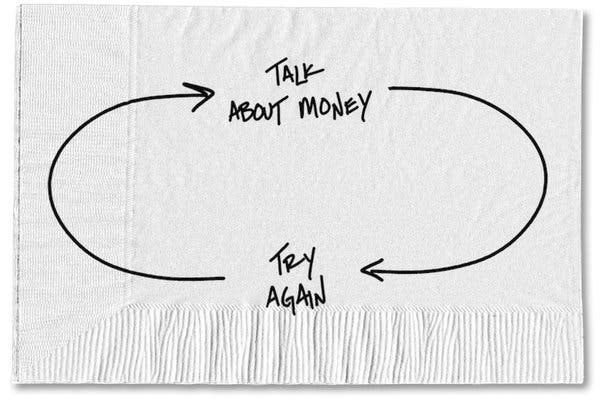
And if that rings true, then you really have just two options. You can end your relationship, in that way ending the fights about money. Or, you can keep trying.

My advice is to keep trying.

Informational Source

Design a site like this with WordPress.com
Get started